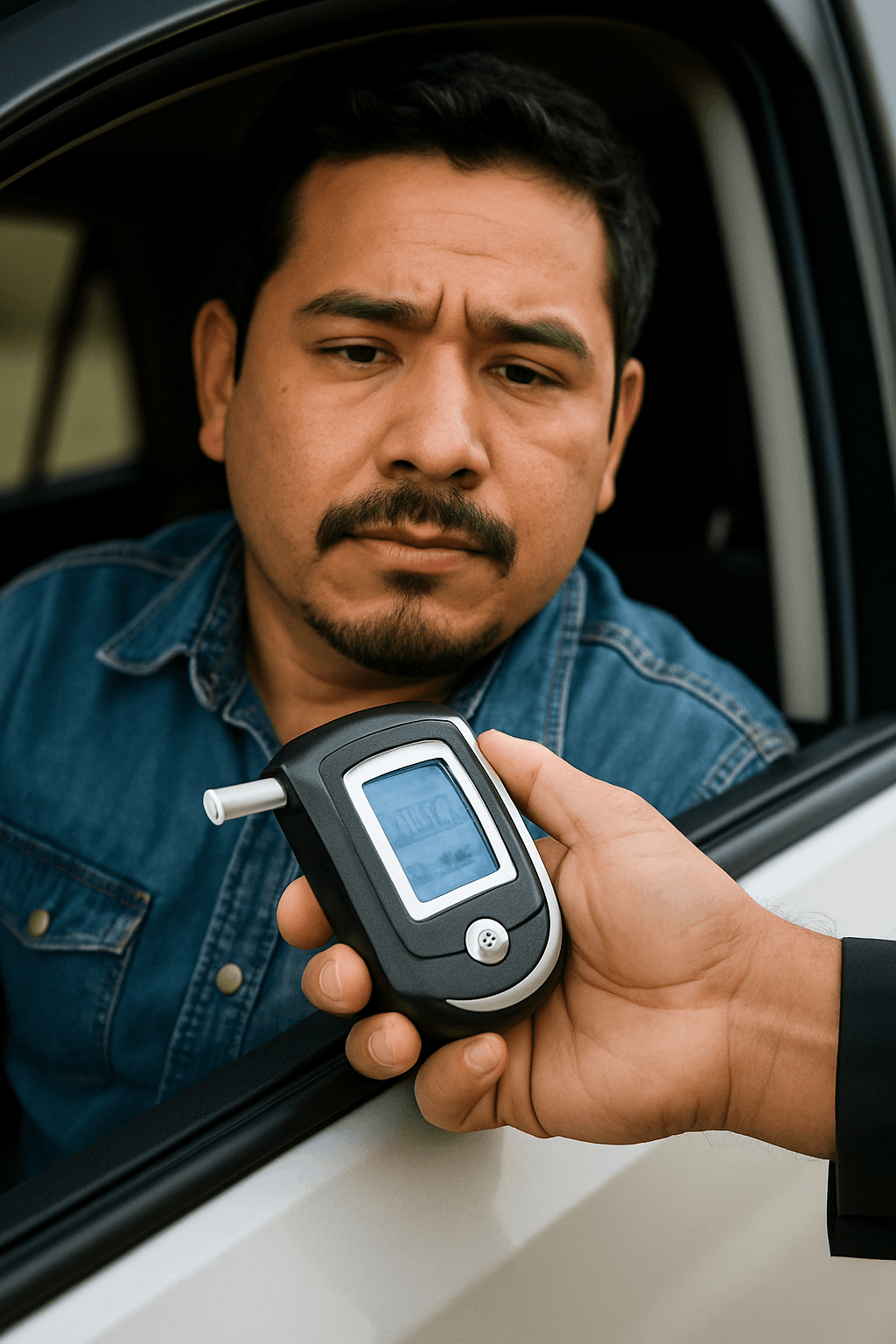
Arizona gives you 15 days to request a hearing after your arrest and 30 days to file SR-22 after conviction. Missing either deadline adds months to your suspension and resets your filing clock.
What happens in the first 72 hours after your Arizona DUI arrest
Arizona MVD confiscates your physical license at the time of arrest and issues a 15-day temporary driving permit. This permit expires regardless of whether you've been formally charged, convicted, or even arraigned. Your criminal court date will be set weeks or months out, but your administrative license suspension begins on day 16 unless you request an MVD hearing within 15 days of your arrest date.
The officer's arrest report triggers two separate processes: the criminal DUI case in court and the administrative license action through MVD. These run on completely different timelines with different agencies. Most drivers focus entirely on the criminal case and miss the MVD hearing deadline, which makes the administrative suspension automatic and non-contestable.
If your BAC was 0.08–0.149% (standard DUI), the administrative suspension is 90 days. If your BAC was 0.15% or higher (extreme DUI), the suspension is 90 days for a first offense but jumps to one year for a second offense within 84 months. If you refused the breath or blood test, the suspension is one year for a first refusal and two years for a second.
How to request your MVD administrative hearing before the 15-day deadline
You must submit a written hearing request to the Arizona MVD Office of Administrative Hearings within 15 calendar days of your arrest. The request form is available on the MVD website or at any MVD office. The filing fee is $50 as of current MVD rules. Mail the request certified or deliver it in person — MVD counts the postmark date for mailed requests.
Requesting the hearing does three things: it preserves your right to contest the administrative suspension, it delays the start of that suspension until after the hearing decision, and it gives you 30–60 additional days of legal driving while the hearing is scheduled. If you do not request the hearing, your temporary permit expires on day 16 and your suspension begins immediately with no appeal.
The administrative hearing is separate from your criminal court case. You can lose the criminal case and win the MVD hearing, or win the criminal case and lose the MVD hearing. The MVD hearing officer evaluates whether the officer had reasonable grounds to stop you, whether you were lawfully arrested, and whether the BAC test was administered correctly. You can appear with an attorney. Most DUI defense attorneys in Arizona handle both the criminal case and the MVD hearing as part of their representation.
Find out exactly how long SR-22 is required in your state
What happens between arrest and conviction while your criminal case proceeds
Your criminal DUI case will move through arraignment, pre-trial conferences, and either a plea agreement or trial. First-offense standard DUI cases in Arizona typically resolve within 60–120 days. Extreme DUI, aggravated DUI, or cases going to trial take longer — sometimes 6–12 months.
During this period, your insurance carrier will be notified of the DUI charge when your policy renews or if you file a claim. Most major carriers including State Farm, Geico, Allstate, and Progressive will non-renew your policy at the end of your current term. Some will cancel mid-term if your policy allows cancellation for license suspension. You are not required to notify your carrier of the arrest, but the carrier will discover it at renewal when they pull your MVD record.
If you requested the MVD hearing and it has not yet occurred, you can continue driving legally on your temporary permit or after the hearing is scheduled. If you did not request the hearing, your license is suspended starting day 16 and you cannot legally drive except on a work permit or ignition interlock restricted license, both of which require separate applications and fees.
What to do in the first 30 days after your DUI conviction in Arizona
Arizona requires SR-22 filing after a DUI conviction, and the filing must be continuous for three years from your conviction date — not your reinstatement date. If you are convicted on June 1, your SR-22 requirement ends on June 1 three years later, even if your license was suspended for part of that time. The three-year clock does not pause during suspension.
You have 30 days from your conviction date to file SR-22 with MVD and pay your reinstatement fee. If your license is suspended, the reinstatement fee is $50 for a standard DUI. If you were convicted of extreme DUI or refused testing, the fee is higher and you must also install an ignition interlock device before reinstatement. Missing the 30-day SR-22 filing window does not prevent you from filing later, but it delays your reinstatement and extends the time you are driving illegally or not driving at all.
SR-22 is not insurance — it is a liability certificate your insurance carrier files electronically with MVD to prove you carry at least Arizona's minimum liability limits: $25,000 bodily injury per person, $50,000 bodily injury per accident, and $15,000 property damage. You must maintain an active insurance policy for the full three years. If your policy lapses for any reason, the carrier notifies MVD within 24 hours and your license is suspended again immediately. The three-year requirement resets to zero on the date of the lapse.
Which carriers write SR-22 policies after a DUI in Arizona and what rates look like
Most standard carriers will not write a new auto policy for a driver with a DUI conviction in Arizona. If you are an existing customer, carriers like State Farm, Geico, Progressive, and Allstate will file SR-22 for you and keep you through your current term, but they typically non-renew when that term ends. New DUI policies are written almost exclusively in the non-standard market.
Carriers actively writing SR-22 policies for DUI drivers in Arizona include Bristol West, Direct Auto, Dairyland, GAINSCO, The General, Safe Auto, Acceptance, and Kemper. Availability varies by ZIP code — not all non-standard carriers operate statewide. Monthly premiums for minimum liability SR-22 coverage after a first-offense standard DUI in Arizona typically range from $140–$210 per month. Extreme DUI or repeat offenses push rates to $200–$320 per month. Estimates based on available industry data; individual rates vary by age, vehicle, ZIP code, and prior insurance history.
You can compare non-standard SR-22 quotes without affecting your credit. Arizona allows carriers to use credit-based insurance scores, but the DUI conviction is the dominant rating factor — your credit score will move your rate within a range, but it will not bring you back to standard-market pricing. Most drivers stay in the non-standard market for 3–5 years after their SR-22 filing period ends, until the DUI conviction ages off their MVD record for rating purposes.
If you do not own a vehicle: how non-owner SR-22 works in Arizona
Arizona accepts non-owner SR-22 policies for drivers who do not own a vehicle but need to satisfy the SR-22 requirement. A non-owner policy provides liability coverage when you drive a vehicle you do not own — a borrowed car, a rental, or a vehicle owned by a household member. It does not cover a vehicle you own or regularly drive.
Non-owner SR-22 policies cost significantly less than standard policies because they carry lower risk — typically $40–$80 per month in Arizona for minimum liability limits. The same non-standard carriers that write standard SR-22 policies also write non-owner policies: Bristol West, Dairyland, GAINSCO, The General. Not all carriers offer non-owner policies in every ZIP code, so availability varies.
If you buy or register a vehicle during your three-year SR-22 period, you must immediately convert your non-owner policy to a standard policy or buy a new standard policy and transfer the SR-22 filing. Driving a vehicle you own on a non-owner policy is insurance fraud and will result in a lapse notification to MVD. For detailed guidance on non-owner SR-22 options and how they interact with Arizona's filing requirements, see non-owner SR-22 coverage resources.
What happens if you miss the SR-22 filing deadline or let your policy lapse
If you do not file SR-22 within 30 days of your conviction, Arizona MVD will not issue or reinstate your license until you file. The SR-22 requirement does not go away — it simply prevents reinstatement until you comply. The three-year SR-22 period still begins on your conviction date, so delays in filing do not shorten your total filing period.
If your SR-22 policy lapses after you have filed — because you miss a payment, cancel the policy, or switch carriers without maintaining continuous coverage — your carrier notifies MVD electronically and MVD suspends your license immediately. There is no grace period. You cannot drive legally from the moment the lapse is reported. To reinstate, you must file a new SR-22, pay a $50 suspension reinstatement fee, and restart your three-year SR-22 clock from the date of reinstatement.
The lapse-and-reset rule is the most common way drivers extend their SR-22 requirement beyond three years. A single one-day lapse resets the clock to zero. Arizona MVD does not prorate or credit time served before the lapse. Most non-standard carriers require monthly automatic payment specifically to prevent lapses, and some will not reinstate a policy after a missed payment — forcing you to find a new carrier, refile SR-22, and pay reinstatement fees.