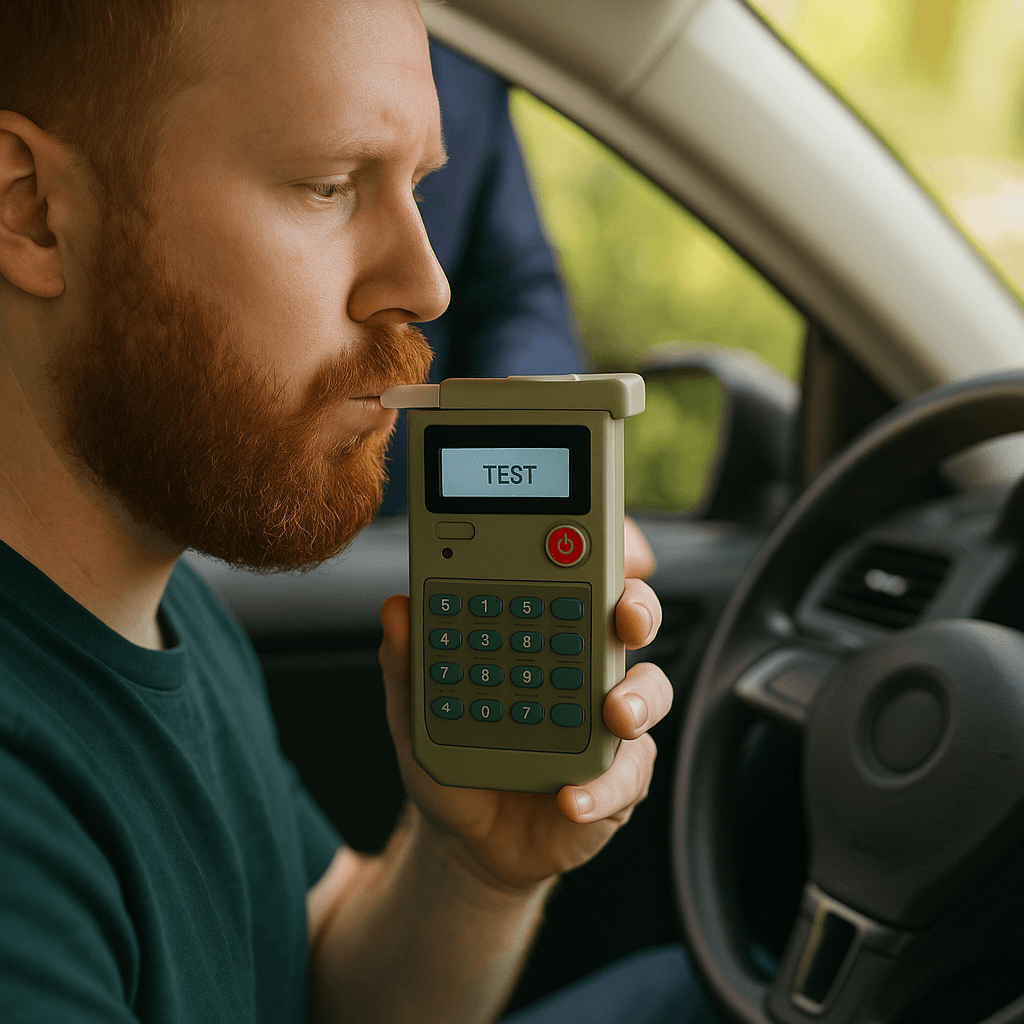
Maine mandates ignition interlock for all DUI convictions with no work vehicle exemption. If you drive a company truck, delivery van, or employer-owned car for your shift job, your restriction applies there too unless your employer agrees to install the device.
Maine Requires IID for All DUI Convictions Including First Offense
Maine law requires ignition interlock installation for all operating under the influence (OUI) convictions, including first-time offenders. The minimum IID restriction period is 150 days for a first OUI conviction, measured from the date you install the device and reinstate your license, not from your conviction date. A second OUI within 10 years triggers a 275-day minimum IID period, and a third conviction mandates 4 years.
The restriction attaches to your driver's license itself through a Secretary of State restriction code, not to a specific vehicle. This means the interlock requirement follows you to any vehicle you operate during the restriction period — personal cars, borrowed vehicles, rental cars, and employer-owned work vehicles. Maine statute 29-A MRS §2508 contains no occupational hardship exemption and no employer vehicle exception.
Your SR-22 filing requirement runs concurrently with your IID period. Most carriers require you to maintain both the device and the SR-22 certificate for the full duration set by the court and the Bureau of Motor Vehicles. If the IID is removed early or you drive a non-equipped vehicle during your restriction period, your SR-22 filing period resets to day zero in most cases.
No Work Vehicle Exception Exists Under Maine Statute
Maine provides no statutory carve-out for work vehicles. If your job requires you to drive a company-owned delivery van, dump truck, forklift with road access, or any employer vehicle during your IID restriction period, you cannot legally operate that vehicle unless the employer installs an approved ignition interlock device in it. The restriction code on your license applies to every vehicle you drive, regardless of ownership or purpose.
The Maine Bureau of Motor Vehicles does not issue restricted work permits or occupational licenses that exempt company vehicles from the IID requirement. Some states allow hardship licenses with employer vehicle exceptions — Maine is not one of them. Your only legal option is to have an approved IID installed in the work vehicle at your employer's expense, or to arrange alternative job duties that do not require you to drive.
Employers rarely agree to install interlock devices in fleet vehicles. Installation costs range from $70 to $150, monthly lease and calibration fees run $60 to $90 per month, and the device must be serviced every 30 to 60 days at a certified service center. Most companies decline because the device restricts vehicle use to you alone during your shift, complicates fleet logistics, and creates liability questions if the device records a violation while the truck is assigned to you.
Find out exactly how long SR-22 is required in your state
What Happens If You Drive a Company Vehicle Without IID Installed
Operating any vehicle without a properly installed and functioning ignition interlock during your restriction period is a Class D criminal offense in Maine under 29-A MRS §2557. A first violation carries up to 364 days in jail, a fine of up to $2,000, and an automatic license suspension of at least one year. Your original IID restriction period restarts from zero, meaning a 150-day requirement becomes 150 days plus however long your new suspension lasts.
Most employers terminate immediately if they discover you drove a company vehicle with an active IID restriction. The company's commercial auto liability policy excludes coverage for drivers operating in violation of license restrictions, which means any accident you cause while driving without the required device exposes the employer to uninsured liability and potential negligence claims. Fleet managers run MVR checks quarterly or semi-annually — your restriction code will appear.
Your SR-22 carrier will also non-renew or cancel your policy if a violation appears on your driving record during the filing period. Non-standard carriers that write post-DUI SR-22 policies in Maine include The General, Bristol West, Dairyland, and GAINSCO, but all require continuous compliance with court-ordered restrictions. A second OUI or an IID violation moves you into assigned risk pool territory, where monthly premiums often exceed $400.
Hardship License Options in Maine Are Extremely Limited
Maine does not issue traditional hardship or occupational licenses. The state's only restricted license program during an OUI suspension is the work-restricted license available under 29-A MRS §2508, which permits driving to and from work, school, medical appointments, and court-ordered programs — but only if you install an ignition interlock device in the vehicle you drive. There is no version of this license that exempts you from the IID requirement for employer vehicles.
To qualify for a work-restricted license in Maine, you must complete an alcohol and drug program approved by the Office of Behavioral Health, pay a $50 application fee, provide proof of employment or school enrollment, and install an IID in any vehicle you will operate. The Bureau of Motor Vehicles issues the restricted license with a notation that you may drive only for work, education, or treatment purposes and only in a vehicle equipped with an approved device. The restriction does not distinguish between vehicles you own and vehicles your employer owns.
If your employer refuses to install an IID in the work vehicle, your restricted license allows you to drive a personal car or a family member's car to and from your job site, but it does not permit you to drive the company truck, van, or equipment once you arrive. Some shift workers lease or borrow a personal vehicle specifically for the commute, then perform non-driving duties at the job site during their restriction period.
SR-22 Filing and IID Compliance Both Required Simultaneously
Maine requires SR-22 filing for all OUI convictions, and the filing period must overlap with your IID restriction period. Most first-offense OUI drivers in Maine must maintain SR-22 for 3 years from the date of conviction, while the IID requirement lasts a minimum of 150 days from installation. Your carrier must file the SR-22 certificate with the Maine Bureau of Motor Vehicles before you can reinstate your license and install the device.
Non-standard carriers that write SR-22 policies for Maine DUI drivers typically charge $100 to $180 per month for state minimum liability coverage (50/100/25). Adding the monthly IID lease and calibration cost of $60 to $90 brings your total monthly compliance cost to $160 to $270 before factoring in reinstatement fees, alcohol program costs, or increased insurance premiums. If you finance device installation, expect an additional $15 to $25 per month.
Your IID provider reports directly to the Maine Secretary of State. Any failed startup test, missed calibration appointment, or tampering event appears on your compliance record and can trigger a violation hearing. If the Bureau determines you violated IID terms, your restricted license is revoked immediately and your full suspension period resumes. Your SR-22 carrier receives notice of the revocation, and most will cancel your policy within 30 days, which triggers a new SR-22 lapse and extends your total filing requirement.
Alternative Job Arrangements During Your IID Period
If your employer cannot or will not install an IID in the work vehicle, you have three realistic options. First, negotiate a temporary role change that eliminates driving duties — warehouse work, dispatch, inside sales, or equipment maintenance roles that keep you on-site. Many shift employers will accommodate this for 150 days if you are otherwise a reliable employee, especially in industries facing labor shortages.
Second, arrange your own transportation to the job site using a vehicle equipped with an IID, then perform non-driving duties once you arrive. This works for construction workers, delivery helpers, and service techs who ride along but do not operate the vehicle. Some workers buy a high-mileage used car for $2,000 to $4,000, install the IID, and use it solely for commuting during the restriction period, then sell it once the device is removed.
Third, change employers temporarily to a position that does not require driving. Retail, food service, call center, and manual labor jobs in Maine pay $15 to $19 per hour and do not require a clean driving record. The loss of income compared to a CDL or delivery job is significant, but it preserves your compliance timeline and avoids a criminal charge for operating without the required device. Once your IID period ends and your full license is reinstated, you can return to driving-based work with a completed restriction on your record rather than a new OUI or violation charge.